Texas – not TCU, nor Cincinnati or Boise State – is playing Alabama in the BCS championship game because, well, its name is Texas.
The system is designed to reward the big brands of the sport. Just as important as what you did this week, or this month, is what you did a decade ago. Perception is everything. The BCS sells this as fair.
Maybe Texas is the best team, maybe it isn’t. To the naked eye there’s no easy answer.
It is why, according to a Sports Illustrated poll, 90 percent of fans don’t approve of the BCS. We want to find out on the field.
In response to the system’s crushing unpopularity, the BCS has hired a Washington public relations firm, Ari Fleischer Sports Communications, to “defend” its image. The results have been comical. The firm is used for political fights, not sports ones. It’s hard-wired to operate with typical Beltway gumption, which is why it’s failing miserably.
Fleischer arrived with a dismissive attitude that all the rubes in fly-over country know nothing and have some nerve to demand change from the entrenched powers profiteering off of them. So he launched a social media campaign full of Washington ruling class arrogance.
“With a playoff, the more you move down the rankings, the more teams have identical records and arguments about why they should be in,” the BCS wrote (if this even counts as English) on Twitter.
Really, choosing among three 9-3 teams for a playoff bid is somehow more difficult than five unbeaten ones? The BCS powers actually think someone would believe this?
On one of its propaganda websites, the BCS asks whether a playoff would really satisfy
everyone?
“NO!!!” it boldly declares.
Who knew Ari Fleischer wrote like a sixth-grade girl on an iPhone?
Give the campaign credit for this: It’s hardly bothering to explain why the BCS is any good.
Instead, it launched a clown-show website (
playoffproblem.com) that claims there can’t be a playoff because college football is incapable of figuring out how one might work.
Sure, every other sports entity on the planet can do it, but we somehow can’t decide how many teams would be in it or where they’d play and so on? So stop asking.
This is a ploy designed to create gridlock. It’s based on the idea fans lack basic mental competency. (After all, how smart could you be? When was the last time
you attended a Georgetown cocktail party?).
Because Ari Fleischer, BCS director Bill Hancock and the rest of the suits are confounded by the mysteries of a playoff, I’ll gladly explain it for them. Below is a simple 16-team playoff that will make them more money, offer more excitement and create a more equitable competition.
I’ve pitched this for a few years but it’s hardly groundbreaking – the NCAA uses essentially the same system to run playoffs in all other divisions of football; and variations are all over the Internet.
Two other writers at Yahoo! Sports and I are currently finishing an investigative book on the BCS that will come out next season. That book will, in clear detail, lay the system bare – the finances, mathematics, biases, waste, contracts, scams, etc.
In the meantime, this is your primer to finding college football salvation while you wait for the Fiesta Bowl matchup of Plessy v. Ferguson.
A seeded 16-team field
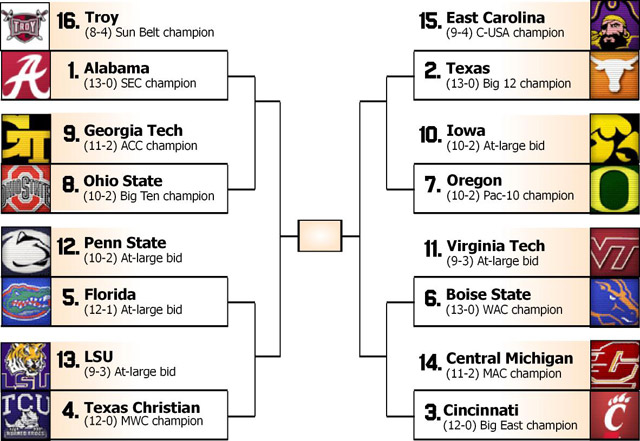
Just like the wildly popular and profitable NCAA men’s basketball tournament, champions of all 11 conferences earn an automatic bid to the playoff.
Yes, all 11, even the lousy conferences. While no one would argue that the Sun Belt champ is one of the top 16 teams in the country, its presence is paramount to maintaining the integrity and relevancy of the regular season. While the idea that the season is a four-month playoff is both inaccurate and absurd – best proven this year – college football’s roller-coaster regular season needs to be protected.
That’s accomplished by two things. The first is playing on the home field of the higher-seeded team until the title game (more on this later).
The second is by giving the chance for an easier first-round opponent – in this case No. 1 seed Alabama would play No. 16 Troy. Earning a top two or three seed most years would present a school a de facto bye into the second round. Why not leave the Sun Belt out and offer a real bye? The extra home game would create tens of millions of dollars in revenue (a carrot to the school presidents).
The season still matters this way. By winning the SEC championship game Saturday, Alabama gets Troy and enjoys home-field advantage in Tuscaloosa until the title game. By losing it, Florida gets Penn State and has to hit the road if it can beat the Nittany Lions.
On the flip side, it brings true Cinderella into the college football mix for the first time. Is it likely that East Carolina could beat Texas? Of course not, but as the men’s basketball tournament has proven the mere possibility (or even a close game) draws in casual fans by the millions.
Perhaps the most memorable college football game of the last few years was Boise State-Oklahoma, in part because Boise was the unbeaten underdog that wasn’t supposed to win. When the Broncos did, in dramatic fashion, they became the talk of the country. There would’ve been historic interest in seeing if they could do it again the following week.
Why wouldn’t college football want that?
For even lower-rated conferences – the Sun Belts, C-USA – allowing annual access to the tournament would not only set off celebrations on small campuses it would actually increase interest for everyone. It would not simply make the regular season matter more it would make more regular seasons matter.
Right now, last Friday’s MAC championship game between Central Michigan and Ohio was virtually meaningless. It wouldn’t be if a berth to the playoffs was riding on it. There’d be a reason to watch.
Who’s against more must-see games?
With the bigger conferences, a championship would take on greater value. Does anyone without direct rooting interest really care that Georgia Tech won the ACC title game Saturday?
They would now. The final week Big East and Pac-10 games (Cincy-Pitt, Oregon State-Oregon) would’ve had greater meaning because if the Panthers and/or Beavers won, it would’ve caused at-large bids to get gobbled up by UC and Oregon.
The interest in every game would increase exponentially – dare I say, every game would actually matter.
At-large bids
In addition to the 11 automatic bids, there would be five at-large selections made by a basketball-like selection committee (a group of highly engaged people using common criteria to pick and set the field).
This is where independents, such as Notre Dame, would have access to the tournament. Most years, all five bids would come from the power conferences (ACC, Big East, Big Ten, Big 12, Pac-10 and SEC).
While the selection process would still draw complaints from the teams left out, those schools often would have two or three losses or significant flaws. In this year’s case, 9-3 LSU would edge out 10-2 BYU in a debate between flawed teams.
There’s no need to dignify the BCS ridiculous assertion that such an argument would be more heated than five unbeatens vying for two title game spots.
Never again would an unbeaten team be denied a chance to pursue a title. And we’d do away with bizarre seasons such as 2003, when everyone thought USC was the best team but the computers locked the Trojans out.
Ignore outdated bowls
BCS bowl games are the single worst business arrangement in American sports. College football’s continued willingness to be fleeced by outside businessmen, who gleefully cut themselves in on millions in profits, makes even conference commissioners blush when confronted with the raw facts.
What other business outsources its most profitable and easily sold product – in this case postseason football?
The bowls were needed back in the 1950s. These days they are nothing but leeches on the system. I happen to like watching bowl games – or any games, but outside of nostalgia they offer no value to a playoff system.
It’ll never make sense to allow businesses outside college football to determine how college football does its business.
College football could stage the 15 playoff games itself, cut out the middle men, and pockets hundreds of millions of extra revenue.
The bowl lobby is a powerful one though, which is why just about every idea you’ll hear or read will use these bowls for the quarterfinals and these for the semifinals and so on. Or they float out the “Plus One” system, which while an improvement to the current BCS, is essentially a desperate Stockholm syndrome compromise. The bowls’ sole concern is keeping their grip on the system when reform inevitably comes.
A neutral site, bowl-based playoff would create ridiculous travel demands on teams and fans. Moreover, going neutral site makes the seeds almost meaningless and, indeed, devalues the regular season.
A playoff that includes bowls is a poor idea. It’s why the BCS clings to it and holds it up as the deal breaker for any and all playoff discussion.
The solution, however, is simple – ignore the bowls.
This isn’t the same as eliminating them. The 34 bowl games can continue to operate outside of the playoff, just like any non-affiliated business. All the non-playoff teams can compete in them. With the BCS, only one game matters any way. It’s not like the Sun Bowl is going to be all that different. If the people of El Paso want to continue staging the game, then they should.
Any claim that such a playoff would kill off all the bowl games is alarmist, dishonest and not based in fact. Any simple analysis of bowl finances show these things are cash cows (why do you think they keep adding bowl games?).
The bowl games will survive as long as two things continue. First, people keep watching football on TV. Since “Bowl Week” is ESPN’s highest rated of the year, don’t count on that changing.
Second, colleges continue to subsidize the bowl system by paying all team expenses and guaranteeing (often at a loss) ticket and marketing revenue. Since the sport will be awash in cash to spend with a playoff, bowls may wind up healthier than ever.
In an effort to help the bowls, first- and second-round losers in a playoff could even return to the bowl pool and take a slot in a late December bowl game if they so choose. That means as few as four teams are pulled out.
As long as they don’t block the playoff, the bowls can go on fine. This is great; the more football the better.
Higher seeds get home games early
The playoff would stage the first three rounds at the home field of the higher-seeded team before shifting to a neutral site, a la the Super Bowl. As a nod to history, it could be a rotation of famed stadiums such as the Rose Bowl. Or the Rose Bowl every year. This doesn’t matter to me.
This allows the playoff to capitalize on perhaps college football’s greatest asset – the pageantry, excitement and history of its legendary campus stadiums. There is nothing like a college game day and it doesn’t matter whether you’re in Tuscaloosa or Ann Arbor or Lincoln or Los Angeles. Each one is thrilling and adds tremendous value to the product.
So why does college football stage its postseason in antiseptic pro and municipal stadiums?
Hosting games would be a boon to the schools. Instead of sharing up to 40 percent of game revenue (and all travel costs) with third-party bowl committees – run by an executive director making up to $800,000 a year – college and universities could keep all money in-house.
Why they’d ever choose otherwise is beyond comprehension.
Home games would pump up local economies too. It’s not the people in Ohio’s job to drop their disposable income in Pasadena; they might consider doing it right at home. The entire “economic impact” theory for bowl games makes no sense on a national scale (which this is) because it’s just displaced spending. Just a guess, but I’m sure the guy running the Columbus Applebee’s would enjoy a crowd as much as the guy running the one in Tempe.
Most importantly it would also reward the higher seeds (again placing value on the regular season) by providing the distinct advantage of playing at home. (The visiting team would get the same small ticket allotment it currently gets). To be a top-two seed, and host through the championships game, would be a considerable advantage.
This would also placate complaints from northern teams who are seemingly always playing bowl games near the campus of their opponent. The Big Ten’s been getting slaughtered of late in bowl games. Well, let’s see Florida or LSU slide around in the snow of Happy Valley some time.
The BCS has all but killed intrasectional games (there’s no reward to playing a tough schedule), but the idea of them returning each December and January, famous jerseys in famous faraway stadiums (USC in the Swamp; Texas in Camp Randall; Oklahoma on the blue turf) can warm any college fan’s heart.
The schedule
While the former Division I-AA plays all four rounds in four consecutive weeks – and stages the title game before Christmas – football’s top division might be better served playing the first one or two rounds in December, breaking for final exams and staging the semifinals just after Christmas and the title game in early January.
While final exams are worth noting, college football players miss very little class time during the regular season (especially compared to other sports). And under the current system, they’re required to have three weeks of practice right in the middle of finals anyway. It’s not like they have time off.
College athletics has never allowed academics to stand in its way before. Even Big Ten commissioner Jim Delany has admitted the academic debate is a complete canard.
One of the apologists’ greatest whines is that a playoff would make the season too long. It’s conceivable that some teams would play 17 games. The guys in the other divisions of college football manage to do it though and as Texas Tech coach Mike Leach points out, the Texas high school season can go 16 games long and the best players are often on both offense and defense. The NFL plays a much longer season with just 53-man rosters.
The length of the season is just another smoke screen.
The presidents
There’s nothing easier than blaming it on the faceless “Presidents.” They don’t want a playoff everyone says and that’s that.
The truth is they’ve never been presented a real playoff plan. If you read their comments about the BCS, it’s obvious few have any idea how college football actually works. It doesn’t help that the same powers that are employing Washington PR firms to muddy the debate waters are the ones briefing them.
One day the campus leaders are going to figure out the facts and things will change. Presidents are obsessed with revenue. If they follow the money, they’ll see they are getting swindled and opinions could change rapidly.
We’re talking billions of dollars in television, game day and marketing revenue that is just lying on the table. Once they realize it’s there, will they really let it sit forever?
“It’s not a question of if there is going to be a playoff, it’s going to be a question of when,” Florida State president T.K. Wetherell said. “It’s going to be driven by money.”
Money we’ve got. Fairness we’ve got. Excitement we’ve got. A playoff plan that would solve all problems and create a four-week event that would rival the NFL playoffs in popularity, we even have that.
See, college football fans aren’t as dumb as the BCS thinks.
http://rivals.yahoo.com/ncaa/football/news?slug=dw-ncaafplayoff120709&prov=yhoo&type=lgns







 Posts
Posts


